Our paper on the outburst and thermonuclear burst properties of SAX J1808.4-3658 was just accepted by ApJ. We used RXTE observations to constrain the distance, deriving a likely range of 3.4-3.6 kpc. We also compared the burst properties to Andrew C's ignition model to deduce the H-fraction at ignition; these bursts are the first confirmed He-rich bursts which have been studied in detail.
Read the paper
>> Full abstract
Abstract:
We analysed Rossi X-ray Timing Explorer observations of the accretion-powered 401 Hz pulsar SAX J1808.4-3658, in order to precisely determine the source distance. While the fluences for the five transient outbursts observed from 1996 were constant to within the uncertainties, the outburst interval varied signficantly, so that the time-averaged flux (and accretion rate) decreased by around 40%. By equating the time-averaged X-ray flux with the expected mass transfer rate from gravitational radiation, we derived a lower limit on the distance of 3.4 kpc. Combined with an upper limit from assuming that the four radius-expansion thermonuclear bursts observed during the 2002 October outburst reached at most the Eddington limit for a pure He atmosphere, we found that the probable distance range for the source is 3.4-3.6 kpc. The implied inclination, based on the optical/IR properties of the counterpart, is i<~30 degrees.
We compared the properties of the bursts with an ignition model. The time between bursts was long enough for hot CNO burning to significantly deplete the accreted hydrogen, so that ignition occurred in a pure helium layer underlying a stable hydrogen burning shell. This is the first time that this burning regime has been securely observationally identified. The observed energetics of the bursts give a mean hydrogen fraction at ignition of approx. 0.1, and require that the accreted hydrogen fraction X_0 and the CNO metallicity Z_CNO are related by Z_CNO approx. 0.03(X_0/0.7)^2. We show that in this burning regime, a measurement of the burst recurrence time and energetics allows the local accretion rate onto the star to be determined independently of the accreted composition, giving a new method for estimating the source distance which is in good agreement with our other estimates.
Labels: 2006, papers, pulsars, thermonuclear bursts
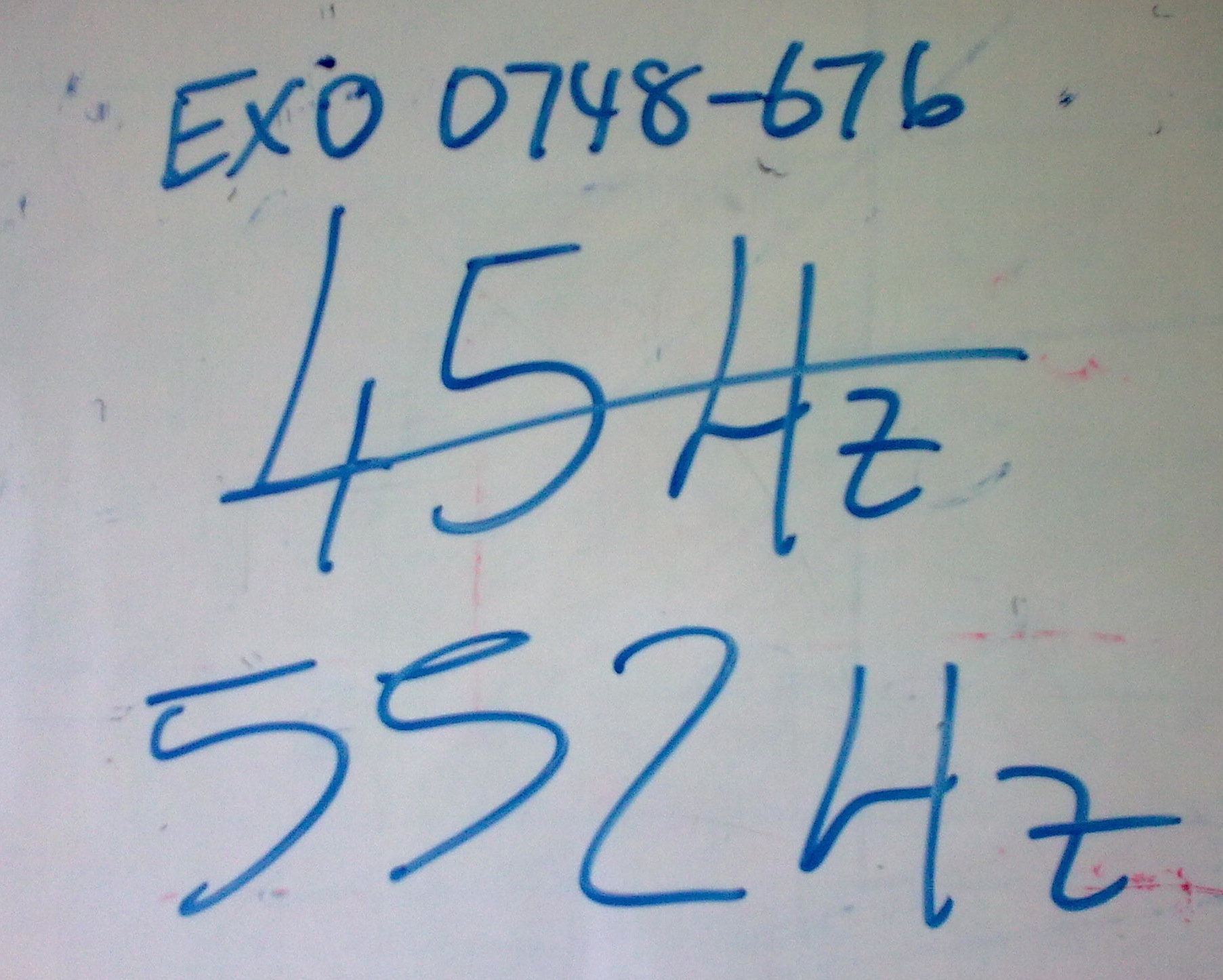 Our recent discovery of 552 Hz burst oscillations in the well-known binary EXO 0748-676 was fairly unremarkable, except perhaps for the extreme rarity of the oscillations (detected in only 2 of ~160 bursts observed by RXTE). However, oscillations had already been detected in this source back in 2004, at 45 Hz. The 552 Hz signal is much stronger, recommending it as the neutron star spin; unfortunately, the Doppler broadening that would be expected by such a spin means that the narrow spectral features previously identified as arising from the neutron star surface, could not have. Our paper has now (Feb '10) been accepted by ApJL.

 Measuring the radius of neutron stars is hard — ask anyone. (They're really small, and really far away; imagine trying to measure something the width of a human hair... on Pluto). The X-ray emission during the bursts seems to come from the entire surface, and is consistent with a blackbody, so it should be possible to infer the radius indirectly, but the apparent radius behaves in very unexpected ways — usually increasing or decreasing during the burst.
 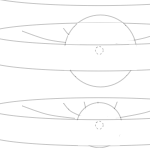 Our paper on the unusually low "touchdown" fluxes for radius-expansion bursts from high-inclination sources was just accepted by MNRAS. Usually the touchdown flux is thought to equal the Eddington flux, but we found that in sources that show X-ray dips — likely arising from structure at the edge of the accretion disk passing across the line of sight, implying that we see these systems almost edge-on — the touchdown flux could be less than half the maximum flux seen earlier in the same burst. The low touchdown fluxes also likely arise from interactions with the disk material, which have some implications for neutron-star distance (but not mass and radius) determination following the method of
  Summer 2007 was a big season for new results on GS 1826-24, the "Clocked Burster". UCSD student
  Alex's paper comparing the observed burst lightcurves from GS 1826-24 with time-dependent models of nuclear burning is finally out. The correspondence is really remarkable, and confirms the solar composition of the accreted fuel, as we suspected from the
  Norbert's paper on the faint-state observations of Cir X-1 has just been accepted to ApJ. While the P-Cygni lines (present in earlier observations when the source was brighter) were absent, we found evidence for complex absorption effects, including warm (moderately ionized) absorbers with varying column density. This Chandra observation has proved popular lately, with
 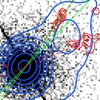 Sebastian did well to spot the X-ray jet in one of Norbert's 2005 zero-phase observations of the enigmatic X-ray binary Cir X-1. This source is thus the first neutron star for which an extended X-ray jet has been detected. Previously ultrarelativistic arcsecond-scale radio jets were detected by Rob Fender's group; see their
 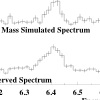 Aimee's paper on the Fe Kα line profiles from the accretion columns of magnetic CVs was accepted by MNRAS last month. The paper extends Jason Cullen's nonlinear Monte-Carlo code to predict the degree of broadening expected from lines arising from close to the white dwarf. We used a Chandra observation of GK Per in outburst for comparison, and while the relative line strengths in the model is not set by the physical conditions, the results were promising.

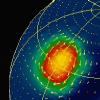 The long-awaited catalog of bursts observed by RXTE has finally been
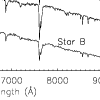 Back in 2003 we made RXTE observations of a new outburst of an old transient last seen in the early '70s, 4U 1901+03. We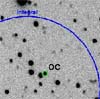
 Analysis of archival Chandra data
of the symbiotic system CH Cygni reveals faint extended
emission to the south, aligned with the optical and radio jets seen in
earlier HST and VLA observations.
CH Cygni is only the
second known
Analysis of archival Chandra data
of the symbiotic system CH Cygni reveals faint extended
emission to the south, aligned with the optical and radio jets seen in
earlier HST and VLA observations.
CH Cygni is only the
second known 
 RXTE observations reveal the 18.7 s
pulsar KS 1947+30 to be in an almost circular 40.415 d orbit. We found evidence for a
"glitch" - an abrupt increase in the neutron star spin frequency - previously observed
only in radio pulsars and AXPs.
RXTE observations reveal the 18.7 s
pulsar KS 1947+30 to be in an almost circular 40.415 d orbit. We found evidence for a
"glitch" - an abrupt increase in the neutron star spin frequency - previously observed
only in radio pulsars and AXPs.
 Analysis of the regular thermonuclear bursts from GS 1826-24 provide the best verification yet of theoretical ignition models. Solar metallicity models naturally reproduce the observed burst energies, but not the recurrence time variation.
 Gravitational radiation - ripples in the fabric of space predicted by
Albert Einstein - may serve as a cosmic traffic enforcer, protecting
reckless pulsars from spinning too fast and blowing apart.
Gravitational radiation - ripples in the fabric of space predicted by
Albert Einstein - may serve as a cosmic traffic enforcer, protecting
reckless pulsars from spinning too fast and blowing apart.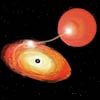 MIT scientists have found a pulsar in a binary system that has all but completely whittled away its companion star, leaving this companion only about 10 times more massive than Jupiter.