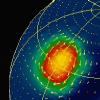
 The long-awaited catalog of bursts observed by RXTE has finally been published in ApJS, and is also out on astro-ph/0608259. The preprint version omits the extended figures; click below for a full abstract, more complete versions, and data tables.
>> Read more
Abstract
We have assembled a sample of 1187 thermonuclear (type I) X-ray bursts from observations of 48 accreting neutron stars by the Rossi X-ray Timing Explorer, spanning more than 10 years. The sample contains examples of two of the three theoretical ignition regimes (confirmed via comparisons with numerical models) and likely examples of the third. We present a detailed analysis of the variation of the burst profiles, energetics, recurrence times, presence of photospheric radius expansion, and presence of burst oscillations, as a function of accretion rate. We estimated the distance for 35 sources exhibiting radius-expansion bursts, and found that the peak flux of such bursts varies typically by 13%. We classified sources into two main groups based on the burst properties: (1) both long and short bursts (indicating mixed H/He accretion), and (2) consistently short bursts (primarily He accretion), and we calculated the mean burst rate as a function of accretion rate for the two groups. The decrease in burst rate observed at >0.06ṀEdd (>~2×1037 ergs/s) is associated with a transition in the persistent spectral state and (as has been suggested previously) may be related to the increasing role of steady He burning. We found many examples of bursts with recurrence times <30 minutes, including burst triplets and even quadruplets. We describe the oscillation amplitudes for 13 of the 16 burst oscillation sources, as well as the stages and properties of the bursts in which the oscillations are detected. The burst properties are correlated with the burst oscillation frequency; sources spinning at <400 Hz generally have consistently short bursts, while the more rapidly spinning systems have both long and short bursts. This correlation suggests either that shear-mediated mixing dominates the burst properties, or alternatively that the nature of the mass donor (and hence the evolutionary history) has an influence on the long-term spin evolution.
ADS link
arXiv.org preprint
Preprint with complete figures (10 Mb PDF)
On-line version of table 5 via VizieR
ASCII version of the burst data (table 5 in the accepted version) + IDL template for use with READ_ASCII
ASCII version of table 9 (burst oscillation properties)
Labels: 2006, 2008, papers, thermonuclear bursts
 The annual meeting of the Astronomical Society of Australia was held this July in Perth, WA. I've never spent much time in Perth, so it was good to spend a little time over there. The UWA campus at Crawley is beautiful, right on the shore of the Swan river, and with fantastic architecture and gardens. We stayed at St. George's College, which is also very picturesque, and backs onto King's Park. The meeting was very well attended and a lot of fun. I gave an invited talk on searches for spectral features from radius-expansion bursts observed by RXTE

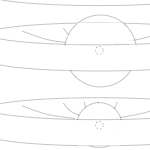 Our paper on the unusually low "touchdown" fluxes for radius-expansion bursts from high-inclination sources was just accepted by MNRAS. Usually the touchdown flux is thought to equal the Eddington flux, but we found that in sources that show X-ray dips — likely arising from structure at the edge of the accretion disk passing across the line of sight, implying that we see these systems almost edge-on — the touchdown flux could be less than half the maximum flux seen earlier in the same burst. The low touchdown fluxes also likely arise from interactions with the disk material, which have some implications for neutron-star distance (but not mass and radius) determination following the method of
  Summer 2007 was a big season for new results on GS 1826-24, the "Clocked Burster". UCSD student