label: thermonuclear bursts

Thursday, April 08, 2010

Astronomical databases

Yesterday George Hobbs from ATNF kindly hosted a teleconference for discussion of various approaches and tools available for astronomical databases. This was motivated by a number of queries he'd had about the ATNF Pulsar database and the related software. There are a variety of possible database management systems available (including the IDL solution I'd been using to date), so it is good to know a little bit more about their pros and cons. Also, there is much work being done, some in the context of the various virtual observatory efforts, in standardising astronomical data and methods of public access.
Below are some useful links and references that came up in the discussion.

  • Tim Cornwall pointed to http://www.astrogrid.org which should be (as others also suggested) the first point of contact for making your data available/compatible to/with VO
  • There is much software already available to view Virtual Observatory compatible data; see the VO-Software section at Euro-VO site, and the International Virtual Observatory Alliance (IVOA) for the data standards etc.
  • Emil Lenc is using MySQL to store data related to the Australia Telescope Large Area Survey (ATLAS). Some suggested that his experience might be the most relevant in terms of people with small datasets wishing to manage them and/or make them public
  • Russel Jurek (?) stood in for Baerbel Koribalski to talk about the HIPASS public data release; they have a nice webpage
  • The other useful reference is last year's Astroinformatics School, which featured presentations on several topics relevant to this discussion

Labels: , , ,

Tuesday, March 16, 2010

Hawaii - Sydney

HEADing to Hawai'iI just got back from the American Astronomical Society's High-Energy Astrophysics Division meeting, which was held in the beautiful Hilton Waikoloa Village resort on the Big Island. On the work side it was very productive; I kicked off the conference on Monday morning with an invited talk on bursts, and also presented a poster on our recent EXO 0748-676 result. Jake Hartman also presented some excellent work on the 2008 outburst of IGR J00291+5934 (poster 42.15). Of course, there was also the chance to catch up with all our old friends and collaborators; this was the best attended HEAD meeting ever! But in a place this beautiful you can't spend your whole time working, so we also took some time to play in the lagoon, and with the dolphins, etc.
On the way back Jasmina & I visited some more friends and colleagues at University of Sydney, and gave some more talks, as well as visiting the amazing Powerhouse Museum, from which it was quite a challenge to extract Aleks...

Thermonuclear bursts and the neutron star equation of state (invited talk 01.01l)
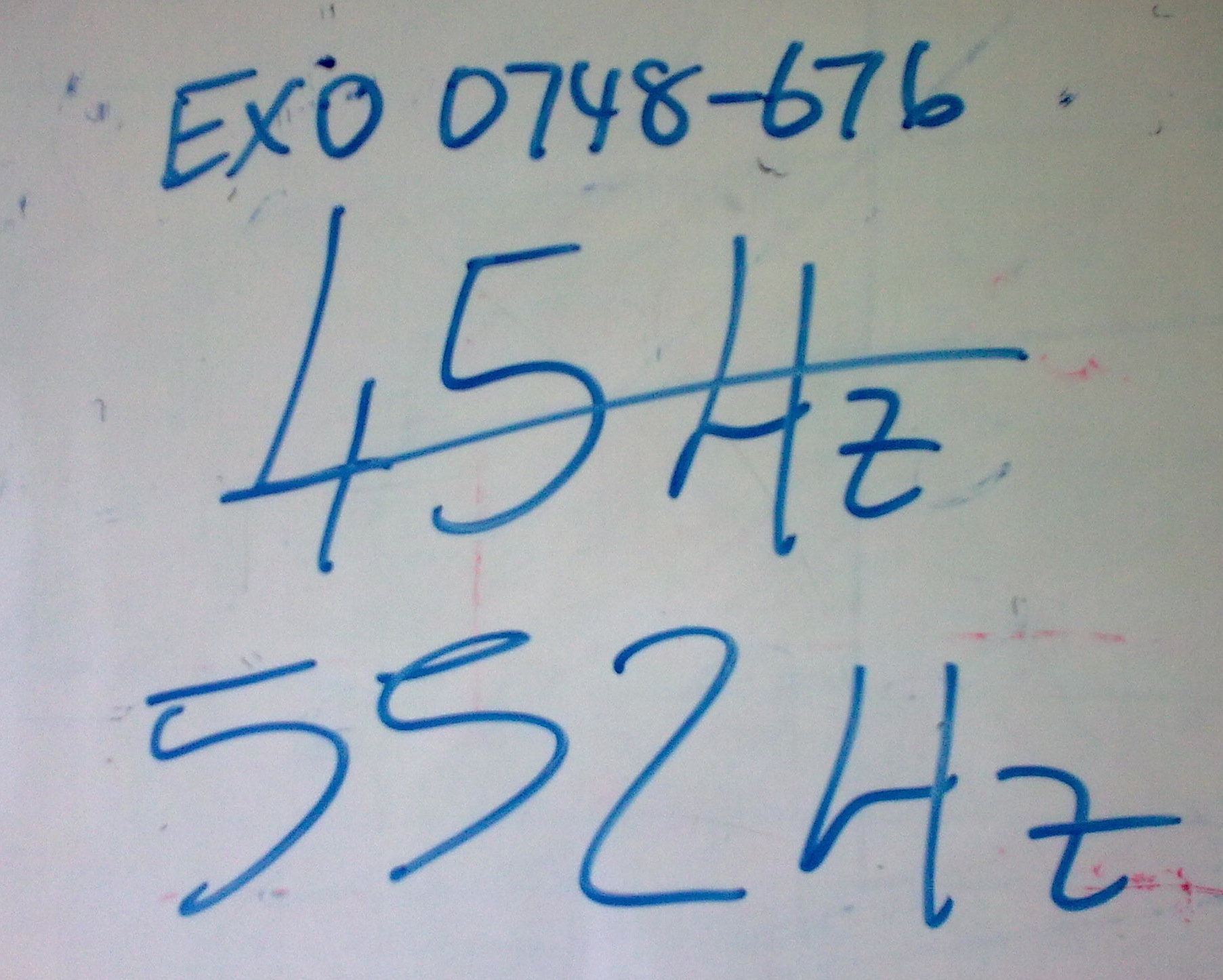
A 552Hz burst oscillation in EXO 0748-676 (poster 42.23)

Labels: , , , ,

Friday, October 30, 2009

It's deja vu, all over again

Our recent discovery of 552 Hz burst oscillations in the well-known binary EXO 0748-676 was fairly unremarkable, except perhaps for the extreme rarity of the oscillations (detected in only 2 of ~160 bursts observed by RXTE). However, oscillations had already been detected in this source back in 2004, at 45 Hz. The 552 Hz signal is much stronger, recommending it as the neutron star spin; unfortunately, the Doppler broadening that would be expected by such a spin means that the narrow spectral features previously identified as arising from the neutron star surface, could not have. Our paper has now (Feb '10) been accepted by ApJL.
Read the paper (arXiv.org/0910.5546)

Labels: , , ,

Tuesday, September 01, 2009

The apparent neutron-star radius during bursts

Measuring the radius of neutron stars is hard — ask anyone. (They're really small, and really far away; imagine trying to measure something the width of a human hair... on Pluto). The X-ray emission during the bursts seems to come from the entire surface, and is consistent with a blackbody, so it should be possible to infer the radius indirectly, but the apparent radius behaves in very unexpected ways — usually increasing or decreasing during the burst. Sudip Bhattacharyya & Cole Miller found a correlation between the slope of the radius evolution and the duration of the burst (a proxy for the burst fuel composition), based on the data from the RXTE burst catalog. Our paper was just accepted by MNRAS.

Read the paper (arXiv.org:0908:4245)
Astronomers get neutron star's measure @ ABC Science

Labels: , , ,

Thursday, July 09, 2009

Thermonuclear bursts at the ASA

The Astronomical Society of Australia held it's meeting this week at U. Melbourne. This annual event brings astronomers from all over the country (and the world) together for a week to catch up, present their research, and also award prizes to researchers and students. I gave a poster describing work on using mixed H/He thermonuclear bursts to deduce the neutron star redshift. Zdenka gave a talk on preliminary results from her comparisons of burst properties and models in the candidate He accretor 4U 1728-34. It was nice to be back on campus at U.Melbourne for a week — great location and even better coffee!

Measuring neutron star parameters from mixed H/He thermonuclear bursts (1.1MB PDF)

Labels: , ,

Monday, May 25, 2009

Defining the neutron star crust meeting

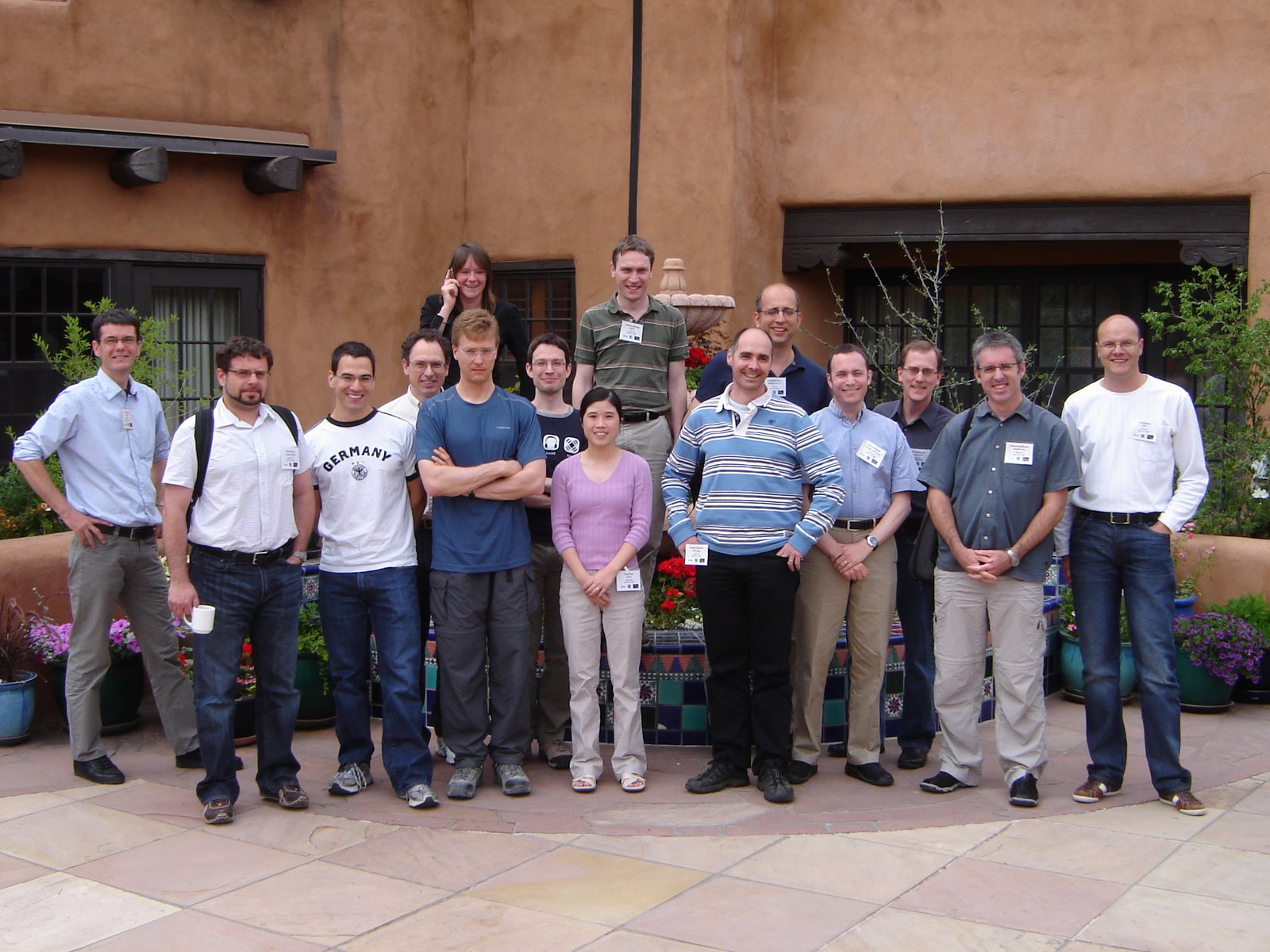
I just got back from a terrific meeting in Santa Fe on the subject of the neutron star crust, and attended by a wide range of nuclear theorists and experimentalists as well as astrophysicists. There were many interesting talks, and I learned a lot; one of the overarching themes was the need for better communication between the various groups — Bob Rutledge was remarkably persistent in asking after almost every talk, "what one thing would you like the other groups represented here to take away from your work?" (to paraphrase a little). The meeting was also one of the most "wired" that I have been to, with a blog including twitter updates, and culminating in the creation of a reddit group called neutronstarstructure to collect relevant papers on the subject.
I gave a talk on some of the recent work I've been doing with determining neutron star redshifts and mass, radius from mixed H/He thermonuclear bursts, which prompted quite a response.

Defining the Neutron Star Crust: X-ray Bursts, Superbursts and Giant Flares
Measuring neutron star parameters from mixed H/He thermonuclear bursts (3.2 MB PPT or 1.5 MB PDF)

Labels: , ,

Tuesday, September 23, 2008

ASA 2008, Perth WA

The annual meeting of the Astronomical Society of Australia was held this July in Perth, WA. I've never spent much time in Perth, so it was good to spend a little time over there. The UWA campus at Crawley is beautiful, right on the shore of the Swan river, and with fantastic architecture and gardens. We stayed at St. George's College, which is also very picturesque, and backs onto King's Park. The meeting was very well attended and a lot of fun. I gave an invited talk on searches for spectral features from radius-expansion bursts observed by RXTE

ASA 2008, Perth WA
ASA talk (2.9MB PDF)

Labels: , , ,

Thursday, August 14, 2008

New outburst of IGR J17473-2721

This system was discovered back in 2005, and was detected in outburst again this March. Since then, it's been observed by Swift, INTEGRAL and RXTE, and even SuperAGILE detected a thermonuclear burst (ATel #1445). Following reports of the bursting activity we triggered some observations with RXTE to search for burst oscillations; we caught some bursts, but no oscillations. Since then, public RXTE observations revealed kHz QPOs and radius expansion bursts, from which we estimated the distance (ATel #1651). Observations are continuing.
See also
INTEGRAL monitoring of IGR J17473-2721
Diego Altamirano's IGR J17473-2721 page
IGR J17473-2721 at SIMBAD

Labels: , ,

Tuesday, June 17, 2008

Burst catalog paper accepted

The burst catalog paper has just been accepted by ApJS! The referee report, by a team of referees, stretched to 11 pages; it took quite a while to address all the (generally constructive) criticisms. In addition, the authors, all at MIT when the project started, are now scattered to the four corners of the US (as well as Australia). The accepted version is (I think) a big improvement on the original, the extra time spent has really helped our understanding of the global burst properties. Check it out for yourself at astro-ph/0608259v2

Click here to read the abstract and download the full version, as well as data tables

Labels: , ,

Thursday, May 01, 2008

US/Netherlands tour

Centraal StationI just got back from a very busy trip around the US, with a stop in Amsterdam on the way home. I presented a couple of posters at the AAS/High Energy Astrophysics Division Meeting in Los Angeles, and went on to visit Ed Brown at JINA, where I gave a lunch talk on the following Monday.

Then it was on to Boston for a brief visit to MIT to catch up with collaborators and friends, as well as a pilgrimage to Toscaninis (sadly the Harvard Square location has closed). After that I had a couple of nights in St. Louis for the APS meeting, and gave an invited talk on burst observations in a special session on the physics of X-ray bursts (L3).

Finally I headed home via Amsterdam for another invited talk at the Decade of Accreting Millisecond X-ray Pulsars workshop at UvA.

HEAD posters 1 2 (0.24/1.22 MB PDF)
APS talk (10.2 MB PPT)
AMSPs workshop talk (1.5 MB PPT) and the proceedings paper

Labels: , , , ,

Tuesday, March 18, 2008

Biases for neutron-star mass, radius and distance measurements

Our paper on the unusually low "touchdown" fluxes for radius-expansion bursts from high-inclination sources was just accepted by MNRAS. Usually the touchdown flux is thought to equal the Eddington flux, but we found that in sources that show X-ray dips — likely arising from structure at the edge of the accretion disk passing across the line of sight, implying that we see these systems almost edge-on — the touchdown flux could be less than half the maximum flux seen earlier in the same burst. The low touchdown fluxes also likely arise from interactions with the disk material, which have some implications for neutron-star distance (but not mass and radius) determination following the method of Özel (2006)
Read the paper (arxiv.org:0712.0412)

Labels: , , ,

Thursday, January 03, 2008

The Clocked Burster is running fast

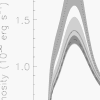
Summer 2007 was a big season for new results on GS 1826-24, the "Clocked Burster". UCSD student Tommy Thompson and I just submitted a new analysis of the X-ray flux–recurrence time relationship in this system. We found a few instances where the thermonuclear bursts — albeit still very regular — occurred more frequently that would be predicted by the relationship derived from a previous study. XMM-Newton observations during one of these episodes revealed the likely presence of an additional soft component, which may account for the "missing" flux. This source may also be useful in future for precision studies of the X-ray flux–accretion rate relationship, which can be measured precisely thanks to the regular bursts.
Read the (accepted) paper (arXiv:0712.3874)

Labels: , ,

Friday, November 09, 2007

Model lightcurves for bursts from GS 1826-24

Alex's paper comparing the observed burst lightcurves from GS 1826-24 with time-dependent models of nuclear burning is finally out. The correspondence is really remarkable, and confirms the solar composition of the accreted fuel, as we suspected from the 2004 paper. However, in that paper we found that the drop in recurrence time with increased flux was more than predicted by Andrew's ignition models; this discrepancy is resolved with the new modelling, which indicates that thermal/compositional inertia play a role in setting the ignition column.

Read the paper (arXiv:0711.1195)

Labels: , ,

Monday, October 22, 2007

Netherlands visit

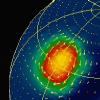
I just got back from a month-long visit to Europe, spending most of my time working at the Space Research Organisation of the Netherlands (SRON) in Utrecht on some thermonuclear burst work. The goal was to combine the RXTE burst catalog with the much larger sample accumulated by the Wide-Field Camera onboard the Italian-Dutch BeppoSAX mission during it's 7-year (1996-2002) mission. We now have a preliminary combined catalog, which we call MINBAR (Multi-INstrument Burst ARchive), and we are working on improving the data products from the BeppoSAX bursts. I also visited the JEM-X instrument team at the Danish National Space Center in order to investigate adding bursts detected by INTEGRAL to the archive.
But it wasn't all work — of course, we also had a nice time sightseeing and catching up with friends and family.

Labels: , ,

Tuesday, August 15, 2006

Thermonuclear bursts observed by RXTE

The long-awaited catalog of bursts observed by RXTE has finally been published in ApJS, and is also out on astro-ph/0608259. The preprint version omits the extended figures; click below for a full abstract, more complete versions, and data tables.
>> Read more Abstract

We have assembled a sample of 1187 thermonuclear (type I) X-ray bursts from observations of 48 accreting neutron stars by the Rossi X-ray Timing Explorer, spanning more than 10 years. The sample contains examples of two of the three theoretical ignition regimes (confirmed via comparisons with numerical models) and likely examples of the third. We present a detailed analysis of the variation of the burst profiles, energetics, recurrence times, presence of photospheric radius expansion, and presence of burst oscillations, as a function of accretion rate. We estimated the distance for 35 sources exhibiting radius-expansion bursts, and found that the peak flux of such bursts varies typically by 13%. We classified sources into two main groups based on the burst properties: (1) both long and short bursts (indicating mixed H/He accretion), and (2) consistently short bursts (primarily He accretion), and we calculated the mean burst rate as a function of accretion rate for the two groups. The decrease in burst rate observed at >0.06ṀEdd (>~2×1037 ergs/s) is associated with a transition in the persistent spectral state and (as has been suggested previously) may be related to the increasing role of steady He burning. We found many examples of bursts with recurrence times <30 minutes, including burst triplets and even quadruplets. We describe the oscillation amplitudes for 13 of the 16 burst oscillation sources, as well as the stages and properties of the bursts in which the oscillations are detected. The burst properties are correlated with the burst oscillation frequency; sources spinning at <400 Hz generally have consistently short bursts, while the more rapidly spinning systems have both long and short bursts. This correlation suggests either that shear-mediated mixing dominates the burst properties, or alternatively that the nature of the mass donor (and hence the evolutionary history) has an influence on the long-term spin evolution.

ADS link
arXiv.org preprint
Preprint with complete figures (10 Mb PDF)
On-line version of table 5 via VizieR
ASCII version of the burst data (table 5 in the accepted version) + IDL template for use with READ_ASCII
ASCII version of table 9 (burst oscillation properties)

Labels: , , ,

Tuesday, July 11, 2006

Helium-rich bursts and the distance to SAX J1808.4-3658

Our paper on the outburst and thermonuclear burst properties of SAX J1808.4-3658 was just accepted by ApJ. We used RXTE observations to constrain the distance, deriving a likely range of 3.4-3.6 kpc. We also compared the burst properties to Andrew C's ignition model to deduce the H-fraction at ignition; these bursts are the first confirmed He-rich bursts which have been studied in detail.
Read the paper

>> Full abstract Abstract:
We analysed Rossi X-ray Timing Explorer observations of the accretion-powered 401 Hz pulsar SAX J1808.4-3658, in order to precisely determine the source distance. While the fluences for the five transient outbursts observed from 1996 were constant to within the uncertainties, the outburst interval varied signficantly, so that the time-averaged flux (and accretion rate) decreased by around 40%. By equating the time-averaged X-ray flux with the expected mass transfer rate from gravitational radiation, we derived a lower limit on the distance of 3.4 kpc. Combined with an upper limit from assuming that the four radius-expansion thermonuclear bursts observed during the 2002 October outburst reached at most the Eddington limit for a pure He atmosphere, we found that the probable distance range for the source is 3.4-3.6 kpc. The implied inclination, based on the optical/IR properties of the counterpart, is i<~30 degrees.

We compared the properties of the bursts with an ignition model. The time between bursts was long enough for hot CNO burning to significantly deplete the accreted hydrogen, so that ignition occurred in a pure helium layer underlying a stable hydrogen burning shell. This is the first time that this burning regime has been securely observationally identified. The observed energetics of the bursts give a mean hydrogen fraction at ignition of approx. 0.1, and require that the accreted hydrogen fraction X_0 and the CNO metallicity Z_CNO are related by Z_CNO approx. 0.03(X_0/0.7)^2. We show that in this burning regime, a measurement of the burst recurrence time and energetics allows the local accretion rate onto the star to be determined independently of the accreted composition, giving a new method for estimating the source distance which is in good agreement with our other estimates.

Labels: , , ,

Wednesday, June 21, 2006

Thermonuclear bursts from the candidate ultracompact binary 1A 1246-588

Some activity recently from an old Ariel V source, 1A 1246-588. It's listed in SIMBAD as a high-mass binary, but recent optical observations instead suggest that it is an ultracompact binary with a very low-mass donor. Then, in late May, the RXTE/ASM detected a flare, which subsequent analysis showed to be consistent with a long thermonuclear burst. (An earlier burst was detected by BeppoSAX). These types of bursts occur in very low-accretion rate sources where a deep fuel layer can build up prior to ignition. There are only a handful of ultracompact binaries in the Galaxy, and substantial interest in their properties and evolution.

See also ATel 875

Labels: ,

Tuesday, November 15, 2005

Korea | Sydney | 4U 1636-536

Sejong University, Seoul, KoreaA busy few weeks, with a trip to Seoul to attend the 7th Pacific Rim Conference on Stellar Astrophysics. I gave a talk (PDF file) on accretion-powered millisecond pulsars, highlighting the recent observations of the latest discovery, HETE J1900.1-2455. Returned via Sydney where I visited a collaborator at U. Sydney and caught up with friends and family.
In the meantime, the long awaited paper on the radius-expansion bursts from 4U 1636-536 was finally accepted. In a study of all the bursts observed by RXTE, we found a bimodal distribution of peak radius-expansion burst fluxes, separated by a factor of 1.7. This is exactly what you would expect if the fainter bursts reach the Eddington limit in an atmosphere containing hydrogen at approximately solar abundances, while the brighter bursts instead occur in a pure helium environment. It remains a mystery exactly how the accreted hydrogen is eliminated from the atmosphere in the brighter radius-expansion bursts.
Read the paper

Labels: , , ,

Saturday, July 31, 2004

The optical counterpart of XTE J1709-267

Jonker et al. report on Chandra and CTIO observations, as well as RXTE observations revealing bursts with an unusual precursor. A similar event occurred in the well-known burster 4U 1636-536
Accepted by MNRAS 22 July 2004

Labels: , ,

Sunday, January 04, 2004

New results from the "Clocked Burster" GS 1826-24

Analysis of the regular thermonuclear bursts from GS 1826-24 provide the best verification yet of theoretical ignition models. Solar metallicity models naturally reproduce the observed burst energies, but not the recurrence time variation.
Read the paper (ApJ 601, 466)

Labels: , ,