The apparent neutron-star radius during bursts
 Measuring the radius of neutron stars is hard — ask anyone. (They're really small, and really far away; imagine trying to measure something the width of a human hair... on Pluto). The X-ray emission during the bursts seems to come from the entire surface, and is consistent with a blackbody, so it should be possible to infer the radius indirectly, but the apparent radius behaves in very unexpected ways — usually increasing or decreasing during the burst. Sudip Bhattacharyya & Cole Miller found a correlation between the slope of the radius evolution and the duration of the burst (a proxy for the burst fuel composition), based on the data from the RXTE burst catalog. Our paper was just accepted by MNRAS.
Read the paper (arXiv.org:0908:4245)
Astronomers get neutron star's measure @ ABC Science
Labels: 2009, neutron star EOS, papers, press, thermonuclear bursts
posted at 12:31 AM

 Suzaku (aka ASTRO-EII)
successfully entered its intended orbit early this morning (local time),
according to a
Suzaku (aka ASTRO-EII)
successfully entered its intended orbit early this morning (local time),
according to a 
 Gravitational radiation - ripples in the fabric of space predicted by
Albert Einstein - may serve as a cosmic traffic enforcer, protecting
reckless pulsars from spinning too fast and blowing apart.
Gravitational radiation - ripples in the fabric of space predicted by
Albert Einstein - may serve as a cosmic traffic enforcer, protecting
reckless pulsars from spinning too fast and blowing apart.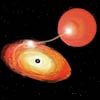 MIT scientists have found a pulsar in a binary system that has all but completely whittled away its companion star, leaving this companion only about 10 times more massive than Jupiter.